Energy exchange between adsorbates and surfaces
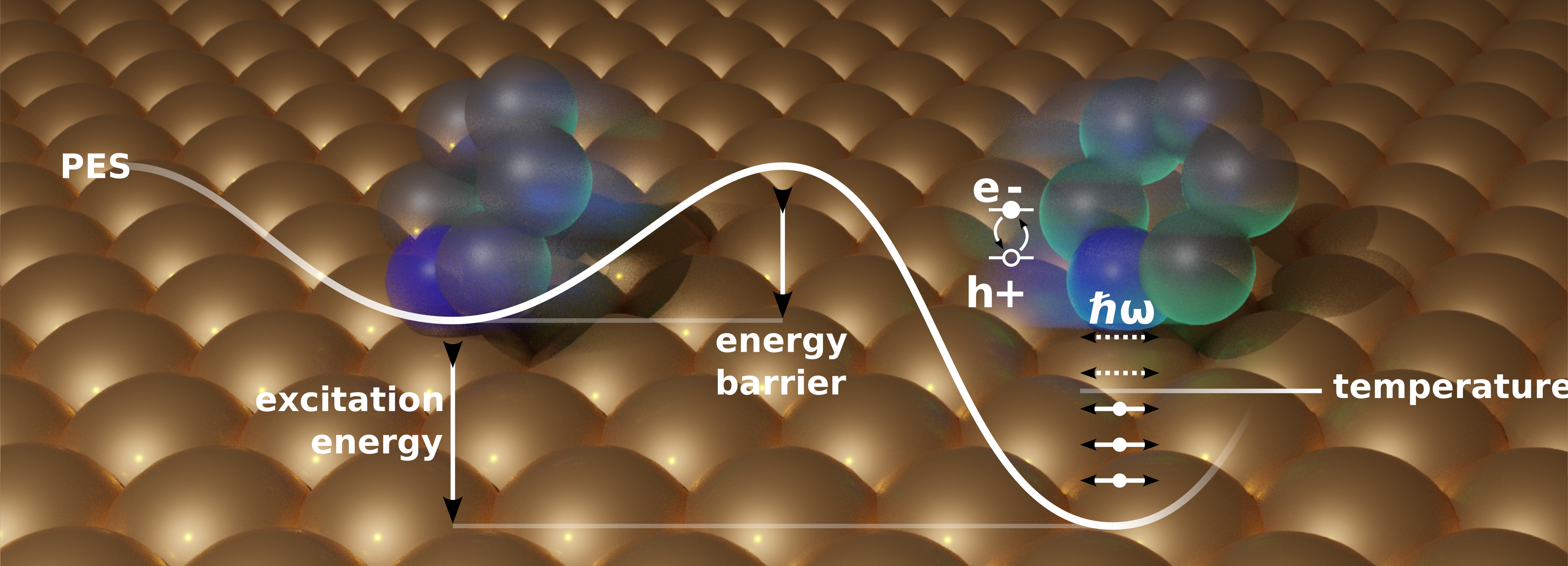
Visualization of adsorbate-surface energy exchange

The interaction between surfaces and adsorbed molecules lies at the heart of many technologies: from catalysis and energy conversion to sensing and nanofabrication. The structure and stability of adsorbates determine whether a molecule binds weakly, diffuses, or activates toward a chemical reaction. At the same time, the exchange of energy between adsorbates and the surface (electrons, phonons) governs how efficiently reactions proceed, how long excited states persist, and how mechanical or thermal energy is dissipated at the atomic scale. By understanding and controlling these processes, we can reveal the microscopic rules that drive reactivity, selectivity, and functionality at surfaces, opening pathways to more efficient catalysts, durable materials, and novel quantum devices.
Projects

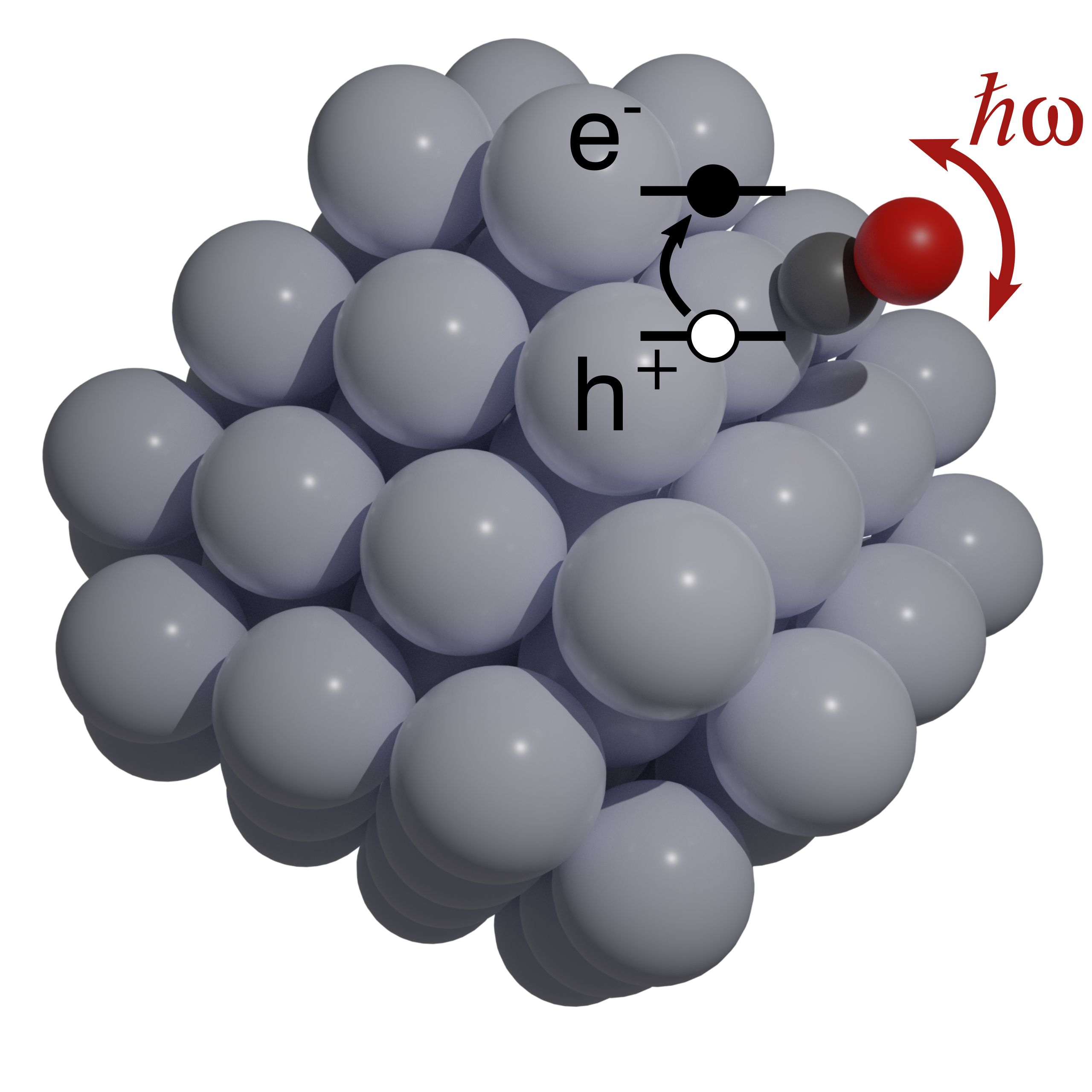
Electron phonon coupling of CO on clusters governed by finite size effects

Cluster where a CO molecule is subject to electron-phonon coupling

Developing atomistic simulations to understand how surface structure controls energy transfer between electrons and vibrations in light-driven metal nanoparticle catalysis in collaboration with Reinhard J. Maurer. Click to read more...

Understanding Light-Driven Catalysis on Metal Nanoparticles: Metal nanoparticles are widely used as catalysts because they accelerate chemical reactions and play a central role in sustainable energy technologies. When illuminated, these nanoparticles can drive chemical reactions even more efficiently by converting light into electronic excitations that transfer energy to atoms and molecules at the surface. Understanding how this energy flows between electrons and atomic vibrations is essential for designing more efficient photocatalysts. Our research develops atomistic simulations to uncover the microscopic mechanisms behind these ultrafast energy transfer processes. By combining first-principles electronic structure calculations, machine learning, and advanced quantum–classical dynamics methods, we study how electrons and atomic vibrations interact on realistic metal nanoparticles. A particular focus of this project is the influence of nanoparticle surface structure on electron–phonon coupling. Different crystal facets expose distinct atomic arrangements, which can significantly affect how vibrational energy is transferred and dissipated. Using carbon monoxide (CO) as a well-established probe molecule, we determine how vibrational lifetimes and energy-transfer rates depend on the local surface geometry. These insights will help establish design principles for photocatalysts that convert light into chemical energy more efficiently.

Structure and stability of defective 2D materials

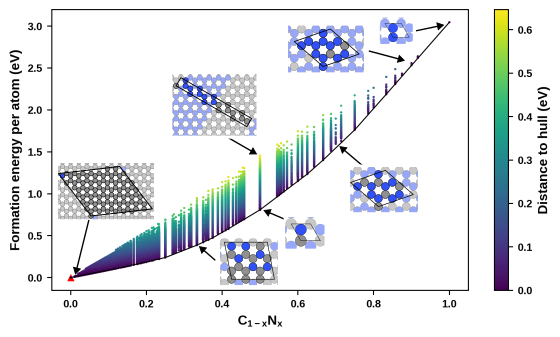
Compositional phase diagram of nitrogen-doped graphene

Developing machine learning models trained on first-principles data to perform high-throughput simulations of 2D materials. Click to read more...

Structure and thermodynamics of 2D materials: Graphene has been studied extensively because of its exceptional mechanical, electrical, and thermal properties. Introducing dopants and lattice defects provides a powerful route to tailoring these properties for applications in electronics, sensing, and catalysis. Rational design of graphene-based materials therefore requires precise control over the type, concentration, and spatial arrangement of defects, which in turn demands a fundamental understanding of their thermodynamic stability and interactions within extended defect superstructures. Achieving this understanding requires first-principles simulations of graphene surface structures. However, the enormous configurational space of possible defect arrangements makes exhaustive first-principles calculations computationally prohibitive. Machine learning approaches, such as Bayesian linear regression and equivariant neural networks, provide accurate surrogate models for the energies and forces of 2D structures, enabling efficient exploration of complex defect landscapes. Beyond this, finite-temperature effects play a crucial role in determining the structure and stability of two-dimensional materials. Thermal fluctuations and entropic contributions must therefore be taken into account. By constructing the partition function, thermodynamic properties such as the free energy, internal energy, entropy, and heat capacity can be derived.

Thermodynamics doped graphene

Ultra-fast energy exchange at surfaces

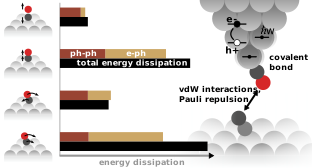
Energy dissipation channels of CO on Cu-substrate geometries

First-principles study of dynamic friction and electronic energy dissipation, supported by a Marie Skłodowska-Curie Fellowship. Click to read more...

Understanding energy dissipation at the atomic scale: The motion of individual molecules on surfaces is governed by their atomic structure and their interaction with the underlying material. When molecules vibrate—either through mechanical manipulation with an atomic force microscope or external excitation—they transfer energy to the electrons and atomic vibrations (phonons) of the surface. This energy dissipation determines how long molecular vibrations persist and plays a central role in nanoscale friction, molecular manipulation, and the interpretation of scanning probe microscopy and surface spectroscopy experiments. Our research combines first-principles simulations with theoretical modelling to understand these processes in single-molecule junctions. Using carbon monoxide (CO) molecules attached to copper tips as a model system, we show that both the geometry of the tip and the coupling between molecular vibrations, substrate phonons, and electrons strongly influence how vibrational energy is dissipated. We find that atomic-scale changes in tip structure can alter vibrational lifetimes by orders of magnitude and reveal how electronic and vibrational interactions work together to control energy flow. These insights provide a fundamental understanding of non-equilibrium processes at surfaces and help guide the design of experiments and nanoscale devices where energy dissipation is a key factor.

Energy dissipation in single-molecule junctions

Atomic-scale friction

Visualization of atomic-scale frictional energy dissipation

Research atomic-scale frictional energy dissipation in collaboration with Jay Weymouth. Click to read more...

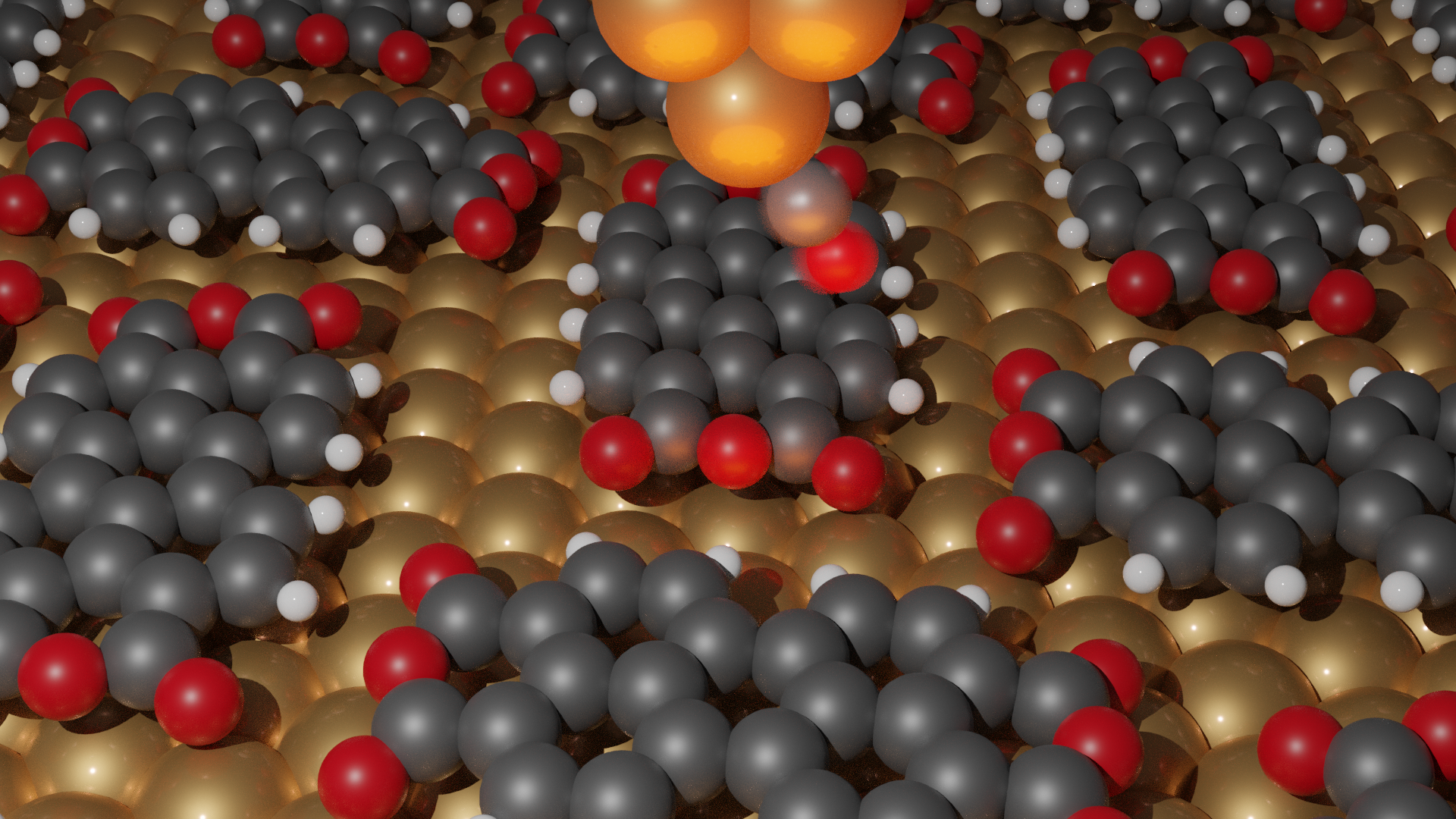
Atomic-scale friction on chemical bonds: Friction influences everything from large-scale engineering systems to the operation of nanoscale devices, yet its microscopic origins remain incompletely understood. By using an atomic force microscope with a tip terminated by a single atom, we can probe friction at its most fundamental level. Oscillating the tip laterally across individual chemical bonds allows us to directly measure the energy dissipated during sliding with atomic precision. Combining these experiments with first-principles simulations, we investigate how the chemical nature of a bond influences friction. Our results show that friction varies significantly even between different aromatic bonds, where it is closely linked to bond order and the distribution of electron density. We also compare aromatic and hydrogen bonds, revealing that similar amounts of friction can arise through different microscopic mechanisms. These insights establish a direct connection between chemical bonding and energy dissipation, providing new strategies for tailoring friction through atomic-scale materials design.

Sliding friction correlates with bond order

Surface structure prediction

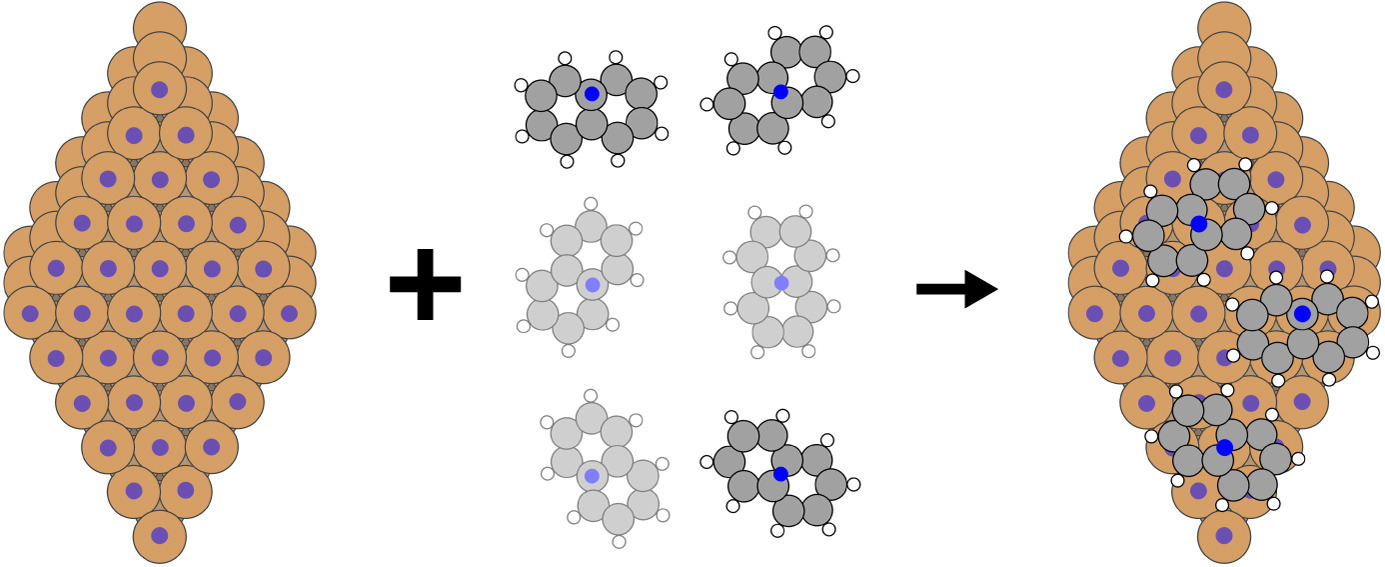
Schematic of building adsorbate-surface structures with SAMPLE

Development of the SAMPLE structure prediction code. Click to read more...

Predicting molecular self-assembly on surfaces: Organic molecules deposited on solid surfaces can spontaneously assemble into a wide variety of ordered structures. Predicting which patterns will form is a fundamental challenge in surface science because the number of possible molecular arrangements grows rapidly with system size, making exhaustive first-principles calculations computationally infeasible. To address this challenge, we developed SAMPLE (Surface Adsorbate Machine Learning for Pattern and Landscape Exploration), a computational framework that combines coarse-grained modelling, machine learning, and first-principles calculations. Using Bayesian linear regression as an efficient surrogate model, SAMPLE rapidly identifies stable molecular arrangements and, together with ab initio thermodynamics, predicts phase diagrams across a range of experimental conditions. We demonstrated the approach for naphthalene on Cu(111), where the predicted surface structures show excellent agreement with experimental observations. SAMPLE enables the efficient exploration of complex molecular self-assembly and provides a powerful tool for the computational design of functional organic interfaces.

Teaching and outreach

Data science for physicists

Visualization of scientific data analysis in Python

An introduction to fundamental theoretical concepts and practical skills oriented toward data science in physics, covering numerical, statistical, and machine learning methods. Click to read more...

Syllabus Highlights:

  • Linear Algebra: Matrix decompositions, eigenvalue problems, and principal component analysis.
  • Differential Equations: Finite difference, integrating first-order and partial differential equations.
  • Fitting and Testing: Regression methods and model testing.
  • Optimization: Local and global optimization methods.
  • Statistics: Statistical/Bayesian hypothesis testing and sampling methods.
  • Machine Learning: Introduction to machine learning and assessing model accuracy.
View Course in u:find

International schools and outreach

Lecturing at an international physics school

Delivering invited lectures and hands-on tutorials at international computational physics and materials science schools. Click to read more...

Recent and Upcoming: Invited presentations at the CAMML spring school in Daresbury and the SCE-PES summer school in Tartu. These sessions focus on advanced computational methods, structure prediction, and non-adiabatic dynamics for early-career researchers.

Publications

About me

Photo of Lukas Hörmann

Dr. Lukas Hörmann

I serve as a Postdoctoral Researcher in Computational Materials Physics at the University of Vienna. My research focuses on non-adiabatic dynamics at surfaces, atomic friction at organic/inorganic interfaces, and the development of machine learning surrogate models.

Click to read full bio...

Academic journey

  • Postdoctoral researcher, University of Vienna (2025–Present): Investigating non-adiabatic dynamics, structure-property relationships, and thermodynamics at surfaces.
  • Marie Curie research fellow, University of Warwick (2023–2025): Focused on electronic and phononic energy dissipation during atomic scale friction, as well as the topological design of defective graphene.
  • PhD and postdoctoral researcher, Graz University of Technology (2018–2023): Researched dynamic sliding friction at the nanoscale and developed machine-learning algorithms to predict molecular arrangements on surfaces.

Software and computational development

  • SAMPLE code: Main developer of the world's first software package enabling quasi-deterministic surface structure search using coarse-grained modeling and machine-learning.
  • FHI-aims: Contributor to the density functional theory code developed by the Fritz Haber Institute.
  • Machine learning: Implemented active learning workflows to train machine learning interatomic potentials and neural network models for tensorial properties.

Teaching and mentorship

  • Curriculum development: Lecturing and developing curricula for bachelor's and master's level courses at the University of Vienna.
  • Supervision: Co-supervising PhD, master's, and bachelor's theses across my tenures at the University of Vienna, University of Warwick, and Graz University of Technology.

Contact

If you’d like to get in touch, feel free to reach out through any of the channels below: